In this guide (15 sections)+
Caring for aging parents is rarely simple. When you live hundreds or thousands of kilometres away, it can become even more complicated.
You may have moved to another city for work. You may be raising your own family somewhere else. Or you may live abroad while your parents remain in the home and community they have known for decades.
Whatever the reason, distance often brings the same questions: Are my parents okay today? Who will help if something happens? How can I support them without taking away their independence?
Long-distance elderly care is not about finding one technology, service, or person who can solve every problem. It is about creating a reliable network around your parents, combining family communication, daily check-ins, trusted local contacts, healthcare support, and a clear plan for unexpected situations.
This guide will help you build that system.
What Is Long-Distance Elderly Care?
Long-distance elderly care refers to supporting aging parents or older family members when you do not live close enough to provide regular in-person assistance. For some families, long distance means living in another part of the same city. For others, it means another state or country.
The practical challenges may differ, but the underlying problem is similar: you care deeply about someone's wellbeing without being physically available every day.
- Regular communication
- Daily wellbeing check-ins
- Medical appointments
- Household support
- Medication routines
- Financial or administrative tasks
- Local caregivers
- Emergency contacts
- Family responsibilities
The goal is not necessarily to manage every part of your parent's life. For independent older adults, the goal may simply be to create enough support that they can continue living the life they prefer while knowing help is available when needed.
Why Long-Distance Care Can Feel Difficult
Distance creates uncertainty. When you live nearby, small concerns are easier to resolve. If your father does not answer the phone, you can stop by. If your mother feels unwell, you may be able to accompany her to a doctor.
When you live far away, the same situations require more coordination. You call. There is no answer. You call again. You message a sibling. You wonder whether to contact a neighbour.
Often, your parent eventually calls back and everything is fine. But the uncertainty between those moments can be stressful. A good long-distance care plan cannot eliminate every worry. What it can do is replace uncertainty with a clearer system.
Start With an Honest Family Conversation
Before adding technology or arranging services, talk with your parents. Ask how they feel about their current situation. What parts of daily life are easy? What is becoming more difficult? Who do they trust nearby? What kind of help would they accept? What kind of help would they dislike?
Adult children sometimes begin with solutions before understanding what their parents actually want. A parent who is living independently may not see themselves as someone who needs to be looked after. The conversation should therefore be about support rather than control.
Instead of saying, "You cannot manage alone anymore," try, "Because we live far away, I want us to have a plan so we know what to do if you ever need help." The best long-distance care system is one your parents are comfortable being part of.
Build a Circle of Support Around Your Parents
No single person should have to manage long-distance elderly care alone. A strong support system usually includes several people who can help in different situations.
- Adult children
- Siblings
- Extended family
- Trusted neighbours
- Close friends
- Household helpers
- Healthcare professionals
- Professional caregivers when appropriate
Not everyone needs to have the same responsibility. A neighbour might simply agree to check the door if nobody can reach your parent. A sibling living nearby might help with medical appointments. Another family member may manage administrative tasks.
The important thing is knowing who can help, and making sure the relevant people can contact each other.
Create a Daily Check-In Routine
One of the simplest parts of a long-distance care plan is a consistent daily check-in. The purpose is straightforward: confirm that the day's normal routine has started as expected.
- A family phone call
- A text message
- A messaging app
- A senior safety application
- A wearable device
- An automated phone call
The method matters less than whether it works consistently for your parent. A regular check-in creates a baseline. If your mother checks in every morning and one day she does not, someone knows to follow up.
A missed check-in does not automatically mean there is an emergency. But without a routine, it may take much longer before anyone notices that something is unusual.
Choose Technology Based on Your Parent, Not Yourself
It is easy to find sophisticated technology for elderly care. There are smartwatches, applications, cameras, sensors, GPS devices, emergency buttons, medication dispensers, and monitoring systems. Some of these can be extremely useful.
But technology only works when the person using it is comfortable with it.
- Does my parent already use this type of technology?
- Will they remember to charge it?
- Will they actually wear it?
- Can they operate it easily when stressed?
- Does it require a smartphone they rarely use?
For a technology-comfortable parent, a smartwatch may be an excellent option. For someone who prefers a traditional phone, a simple phone-based check-in may work better. The most advanced system is not always the most effective. Often, simplicity wins.
Create a Missed Check-In Plan Before You Need It
One of the most important parts of long-distance elderly care is deciding what happens when something does not go according to plan. Imagine your parent normally completes a morning check-in. Today, they do not. What happens next?
- Step 1: Try again. A missed call may simply mean your parent was busy, asleep, outside, or unable to answer.
- Step 2: Contact them through another available method. Try another phone number or communication channel if appropriate.
- Step 3: Contact another family member. Someone else may already know where they are.
- Step 4: Contact a trusted person nearby. A neighbour, relative, or other trusted local contact may be able to check on them.
- Step 5: Escalate appropriately if there is genuine concern. If circumstances suggest an immediate danger, contact the appropriate local emergency services.
Your family's exact process may be different. The important thing is deciding in advance rather than improvising while worried.
Coordinate Healthcare From a Distance
As parents age, healthcare may become a larger part of long-distance support. Depending on their needs and wishes, it can be useful for appropriate family members to know a few essentials.
- Who their regular doctors are
- Which hospital they prefer
- How to reach relevant healthcare providers
- Who can accompany them to appointments
- What support is available locally
Families should handle medical information carefully and respect privacy. The goal is not for adult children to control every medical decision. It is to make coordination easier when parents want or need assistance.
If your parent's health needs become significant, daily check-ins alone may no longer be enough. Professional home care, medical supervision, or other specialised support may become necessary. Long-distance care plans should change as needs change.
Divide Responsibilities Between Siblings
One common problem in elderly care is that responsibility gradually falls on one person. That person becomes responsible for calling every day, managing appointments, talking to doctors, solving household problems, and responding to every concern. Over time, this can become exhausting.
If multiple family members are available, divide responsibilities clearly. One sibling may coordinate healthcare. Another may handle household or administrative matters. Another may maintain contact with nearby relatives.
Technology can help everyone stay informed without requiring one person to constantly send updates. A good family care system should reduce confusion, not create another full-time job for one person.
Long-Distance Elderly Care for NRIs
Families with parents in India and adult children living abroad face additional challenges. Time zones can make daily communication difficult. Travel may require significant planning. In an urgent situation, reaching your parents may take many hours.
For NRI families, local support becomes especially important. Consider identifying at least one trusted person who lives close enough to physically reach your parents when necessary. This might be a relative, neighbour, family friend, or professional caregiver.
It is also helpful to separate daily reassurance from personal communication. Your parent's daily check-in can happen according to their local schedule. Your personal conversations can happen whenever the time difference allows. This removes the pressure of trying to coordinate a daily safety call across multiple time zones.
Respect Independence While Building Safety
A common source of tension between adult children and aging parents is the difference between how each person sees risk. You may think, "What if something happens when nobody is there?" Your parent may think, "I have managed my own life for decades." Both perspectives are understandable.
The goal of a long-distance care plan should not be to remove independence unnecessarily. Instead, look for the least intrusive solution that provides the appropriate level of support.
- A daily check-in
- A trusted neighbour
- An emergency contact plan
- Regular family conversations
For someone with more complex needs, additional professional support may be appropriate. The level of care should reflect the individual's actual situation.
How ParentPulse Fits Into Long-Distance Elderly Care
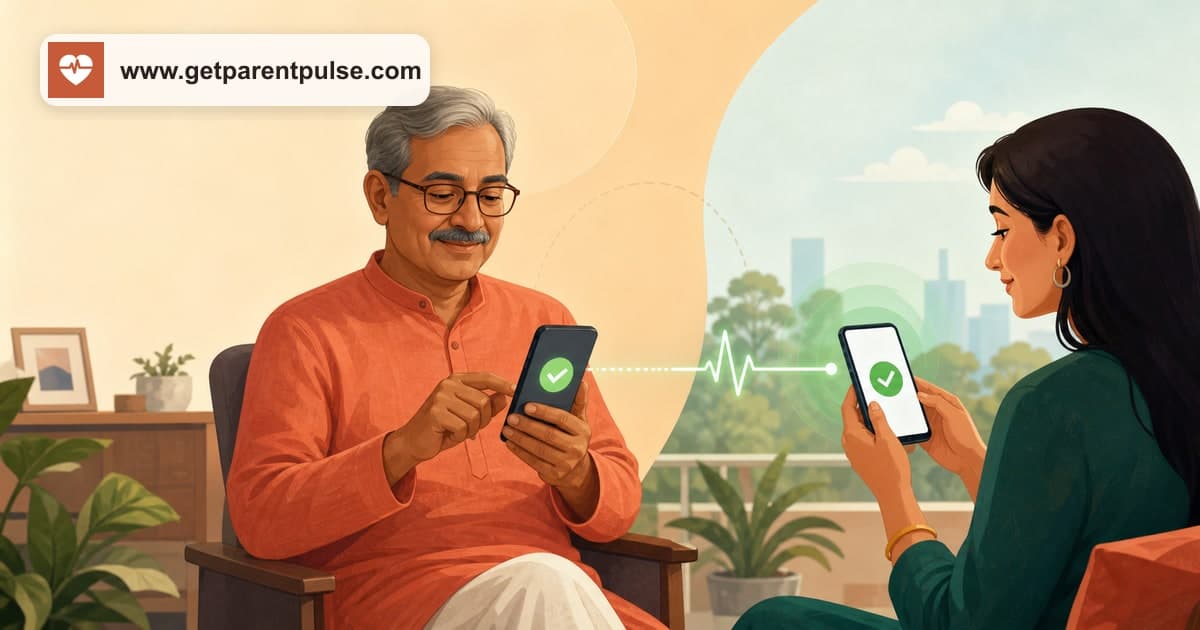
ParentPulse is designed to solve one specific part of the long-distance care challenge: knowing that your parent has checked in today.
A parent receives a scheduled phone call and confirms that they are okay through a simple phone response. They do not need to learn a complicated application just to complete the daily check-in.
When the check-in is completed, the family receives reassurance that the expected routine has happened. If a check-in is missed, ParentPulse can follow the configured process so the appropriate family members or trusted contacts know that someone may need to follow up.
ParentPulse is not intended to replace professional caregivers, medical support, emergency services, family relationships, or trusted people nearby. Instead, it provides one additional layer within a broader care network. Think of long-distance care as a safety net. ParentPulse can be one of the threads.
A Simple Long-Distance Care Plan
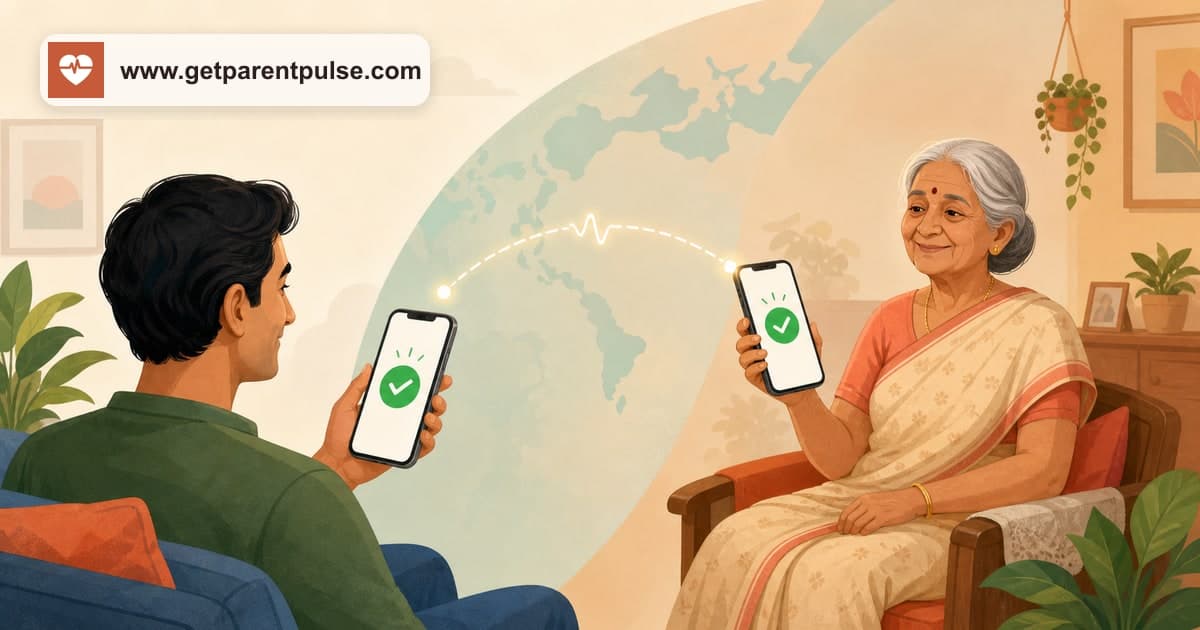
Consider Priya, who lives in New York while her parents live in Jaipur. Her parents are independent and do not need daily professional care. Their support system looks like this: every morning, they complete a simple phone check-in. Priya and her brother know the status of the daily routine.
A trusted neighbour lives nearby and can be contacted if the family cannot reach them. The family has important contact information organised securely. Priya's brother helps coordinate important appointments. The family has agreed on what should happen after a missed check-in.
Priya video-calls her parents regularly, not to monitor them, but to talk. No single part of this system provides complete protection. Together, however, they create a stronger network than relying on occasional phone calls alone.
Review the Care Plan Regularly
Long-distance elderly care is not something you set up once and forget. Parents' needs change. Family circumstances change. Neighbours move. Phone numbers change. Health needs may increase.
Every few months, ask whether the current system still works. Are the right people receiving alerts? Are local contacts still available? Is your parent comfortable with the routine? Does additional support need to be considered?
The best care plan is flexible enough to change with the family.
Frequently Asked Questions
What is long-distance elderly care?+
Long-distance elderly care means supporting an aging parent or older family member when you do not live nearby. It can include regular communication, daily check-ins, healthcare coordination, local support networks, professional care, and emergency planning.
How can I care for elderly parents when I live in another country?+
Build a local support network, maintain regular communication, create a daily check-in routine, organise essential contacts, and establish a clear escalation plan. Professional local care may also be appropriate depending on your parent's needs.
How often should I contact elderly parents living alone?+
There is no universal answer. The appropriate frequency depends on their health, independence, preferences, and support network. Some families use a simple daily check-in alongside longer personal conversations several times a week.
What technology can help with long-distance elderly care?+
Options include phone-based check-ins, mobile applications, emergency alert devices, wearables, sensors, and medication management tools. Choose technology based on your parent's actual needs and comfort level.
What should I do if my elderly parent does not answer the phone?+
Try contacting them again and through another available method. Check whether another family member has spoken with them. If necessary, contact a trusted person nearby. If you have genuine reason to believe they are in immediate danger, contact the appropriate local emergency services.
Can technology replace a caregiver?+
No. Technology can provide useful support and reassurance, but it cannot replace professional care when a person's health or daily living needs require hands-on assistance.
You Can Care Deeply Without Living Nearby
Living far away from your parents can sometimes make you feel as though you are not doing enough. But good care is not measured only by physical distance. It is also about preparation.
Knowing who can help. Creating reliable routines. Having a plan when something seems wrong. Choosing tools that your parents are comfortable using. And continuing to have real conversations that remind them, and you, that distance has not weakened the relationship.
You cannot always be there in person. But you can build a support system that is there every day. ParentPulse helps families add a simple daily phone check-in to that system, providing another way to stay connected when parents and children live far apart.
One simple daily check-in. A stronger connection across any distance.
A little reassurance, every day
Know they’re okay—without another reminder on your list.
ParentPulse makes a daily check-in as easy as answering a call, giving a missed call, or tapping one WhatsApp button.
Join the waitlist →